/
•
•
Detailed stories on technology startups, business and economic current affairs.
At a time when journalism is rotting away, corrections are truly a saving grace. How newsrooms handle them says a lot about their credibility.


There’s one milestone that doesn’t get as much attention as some other rites of passage for journalists. First byline, a prime spot on the front page (or home page), first-ever story to make a big impact, first award—the world of journalism is full of career-defining moments. But that world is equally unsparing. Ask a journalist who has just had their first correction published.
This milestone could be rather mortifying. One could spend days ruing the slip-up, but enduring the discomfiture silently is the only way to get over it. Embarrassing as they might be, errors are an inescapable reality of journalism. And how newsrooms fix their mistakes speaks volumes about their credibility.
“Corrections mean accountability,” says Dhanya Rajendran, co-founder and editor-in-chief of The News Minute, a digital news platform with a focus on India’s southern states. “It reflects that an organization is willing to engage and take responsibility. Trust and credibility in journalism are not built by getting everything right all the time, but by being transparent, responsive and rigorous in how mistakes are acknowledged when it is realized.”
Frankly, there’s no better time than now to talk about corrections. Journalistic standards are plumbing new depths; fake news is the new normal; accuracy is being sacrificed on the altar of speed; there’s more noise than news; anyone with a phone can be a journalist—the whole shebang.
Elisabeth Ribbans, global readers’ editor at Guardian News & Media, doesn’t mince words on the significance of corrections amid such challenges: “To correct an error is firstly, and simply, the right thing to do. Being accountable and open in admitting mistakes is what journalists ask of others every day. But at a time when trust in what we read, see and hear (which I think goes more broadly than journalism) is under increasing strain, I do believe news organizations that take care to be fair and accurate in the first place, and then to correct themselves when necessary and to do so openly, can be a vital counterforce.”
Now, I don’t wish to sound alarmist, but I would strongly suggest we take a serious pause and look at corrections as one of the very few tools left to help reinforce public trust in journalism. What are the ground rules that newsrooms (should) follow for fixing and acknowledging errors? What kind of errors warrant public acknowledgement? What’s the best way to push out corrections? Most importantly, how does it all play out in digital newsrooms where things move dizzyingly fast? Before we tackle these questions, here’s how we handle corrections at The Morning Context, as part of our Editorial Code.
Then again, it would be a bit much to expect editorial policies to cover all the nuances of corrections, what with the fast-paced, high-pressure and chaotic world of news. But we have to start somewhere.
The first step is to decide what deserves to be corrected publicly. A piddling typo, a grammatical slip, a harmless formatting mistake—low-impact lapses such as these can be fixed quietly.
What can’t be shrugged off? “Factual inaccuracies, misattributions, misleading or contextual omissions that alter the understanding of a story should always be explicitly acknowledged,” says Rajendran.
A cardinal rule to keep in mind is whether an error meddles with facts or changes the meaning of a story significantly. “An error that affects readers’ understanding of core details needs acknowledgement,” says Ribbans. “And where there is a directly affected party, setting the record straight publicly can also be important in providing them with fair redress. But my view is generally that if something merits correction, it usually merits acknowledgement too.”
But mistakes are bound to happen, with journalism being conducted at breakneck speed today. “Maybe the first draft of a story will have a fact wrong because, especially in a breaking-news situation, an eyewitness or even the officials on the scene could have conveyed a wrong impression,” says Naresh Fernandes, editor and co-founder of Scroll.in, an independent Indian digital news publication. “[The mistake] should get corrected as new versions of a story proceed and that should be acknowledged.”
Any journalist worth their salt will agree that misspelling (or misstating) the name of an organization, person or a place can have real-world consequences. Similarly, there’s no excuse for botching numbers, even though most journalists are believed to suck at math. But not all decisions involving errors are as straightforward.
Among the most delicate cases, says Ribbans, can be those involving personal relationships where someone comes forward to challenge an account of family events or some shared history. “It could be something that seems small in the overall context of the piece, but it matters deeply to the complainant,” she explains. “Apart from the need to tread sensitively and not to intrude further than is required, there can be all kinds of considerations to be made in these cases, such as one person’s right to speak about their own life as they sincerely see or remember it, while allowing that someone else would in good faith describe those same events very differently.” She does, however, add that “some things are ultimately not amenable to a finding of ‘fact’ or a published correction, but a fair consideration of people's concerns and potential remedies is still important”.
But what’s absolutely unpardonable is selective omission or, worse, fabrication. In mid-October 2023, for example, while covering the Israel-Gaza conflict, a couple of BBC News presenters referred to pro-Palestinian demonstrators across Britian as being backers of Hamas. Public backlash ensued and the BBC had to eventually own up to what turned out to be obvious misreporting.
Which brings us to the next step: owning up to errors.
“We need to convey decisively that we are not infallible and that we will make mistakes, and when we do, we must acknowledge them,” says Fernandes.
Conveying that you are at fault entails some key decisions. For example, where would you place the correction, or how much prominence should it be given? Corrections often go as a note at the bottom or the top of a story. Several leading news organizations also have dedicated sections—both online and in print—where they list corrections and clarifications.
However, the display of corrections “is only rarely loud,” says Sevanti Ninan, a veteran media commentator and founding editor of The Hoot, a media watch website that had a nearly two-decade run. “The display of the correction varies with intent. Whether it is just to correct an inaccuracy or remedy damage to someone or some entity. Only when there is a serious error in reporting is there a prominently displayed correction. Or when there is an error that concerns someone who matters.”
Equally important are the tone and the language. No matter how big or small an error is, the best course of action is to be as detailed and direct as possible; downplaying things could do more harm than good. “The tone of corrections should be clear and factual without being evasive or defensive. The language should prioritize clarity, respect and transparency,” says Rajendran.
Speaking of evasiveness, newsrooms might be tempted to skip stating the actual error while issuing a correction. Like we did late last year, when we incorrectly stated a company’s market capitalization and later appended a note at the bottom saying that we had fixed it. The jury, though, is still out on whether an error needs to be included in the correction. The New York Times, for instance, makes it a point to restate the error. An example is this article from 2019 that misstated the number of bacteria per square inch on the average toilet seat. The note at the bottom not only mentions both the error (50 million) and the correction (50), it also says the mistake stemmed from an editing error, a practice the publication routinely follows.
To be fair to the BBC, it did publish a note after its aforementioned coverage of the Israel-Gaza conflict. While it did well to take ownership of the mistake, just saying sorry in a grave matter such as this one doesn’t always cut it. There’s no mistaking the larger failure of journalistic integrity in this case; the organization has faced similar criticism in its subsequent coverage of the conflict. But that’s a topic for another day.
Coming back to corrections, any discussion would be incomplete without factoring in the online nature of news today.
The online landscape makes it possible for errors to be fixed as soon as they are identified. Unfortunately, though, there’s no easy way to contain their spread online. But it helps to be mindful of how corrections appear on social media, that quicksand of misinformation where logic and reason often tend to sink. Most news organizations take down posts carrying links to the flawed story and put out the corrected versions. In case a post itself contains wrong information, it’s best to prioritize sharing the correction over simply deleting the post. However, if an erroneous post risks the spread of misinformation or is entangled in legal action, it needs to be taken down immediately.
Dealing with errors on social media is not always a losing battle, though. Some journalists know this better than others. Like Brian Stelter, a media reporter at The New York Times until 2013. In a 2012 article by Stelter about the growing acceptance of gay characters in television, Bill O’Reilly, former Fox News host, was misrepresented as being critical of the inclusion of a transgender contestant on a reality show. It was, in fact, a psychiatrist O’Reilly had interviewed who complained about the contestant’s presence on the show. Stelter admitted his mistake on X (formerly Twitter). But Stelter is also an exception; it takes a lot of nerve to own up to your mistakes publicly.
Especially because social media raises the stakes considerably. “For independent newsrooms operating in a polarized political climate, even small mistakes can be amplified and weaponized,” says Rajendran. “One screenshot of the mistake can live forever on the internet and be used to discredit independent journalism. This makes accuracy crucial—but it also makes transparent, timely corrections all the more important.”
The digital nature of newsrooms also means there are far more corrections than ever. And as often happens in life, too much of a good thing can be bad. “The problem sometimes is that people say, oh, they make so many mistakes. Which is perhaps the flip side of this,” says Fernandes. At the same time, he adds that “it actually enhances the trust of an audience that is approaching you in good faith.”
The hard truth remains, though: as long as there is journalism, there will be lapses. But if newsrooms can handle corrections effectively, the future of journalism is not without hope.
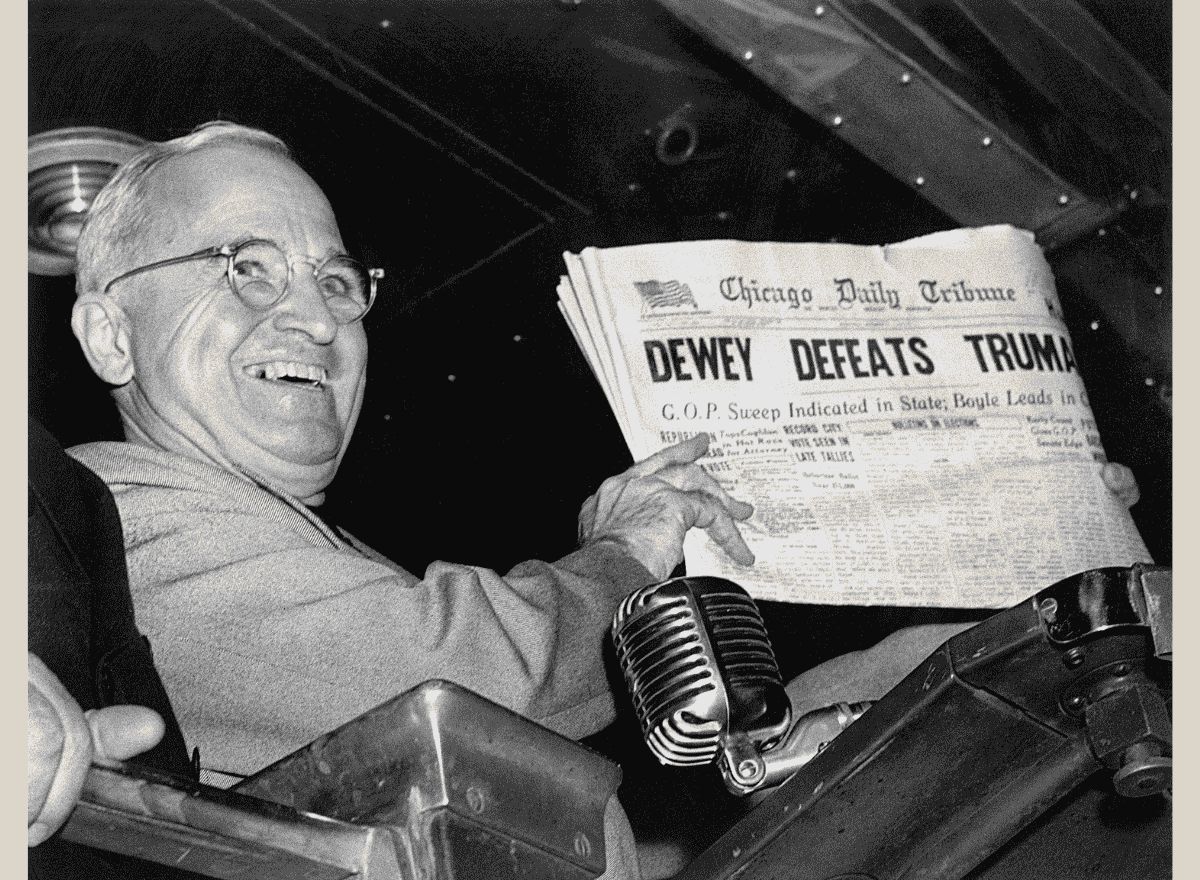
P.S. The lead image, that of a beaming Harry Truman holding up a copy of the Chicago Tribune, would have been impossible if it weren’t for the legendary headline error made by the newspaper. While covering the US presidential election in 1948, the paper erroneously declared Republican Thomas Dewey the winner and ran a front-page headline: “Dewey defeats Truman”. Instead, it was Truman who emerged victorious. The rest is history.
Cover image from Wikimedia Commons